


Which Business Intelligence Software Helps Direct Sellers Identify Emerging Sales Trends?
Pubblicato il
August 14, 2026
Di:
Rick Brisse
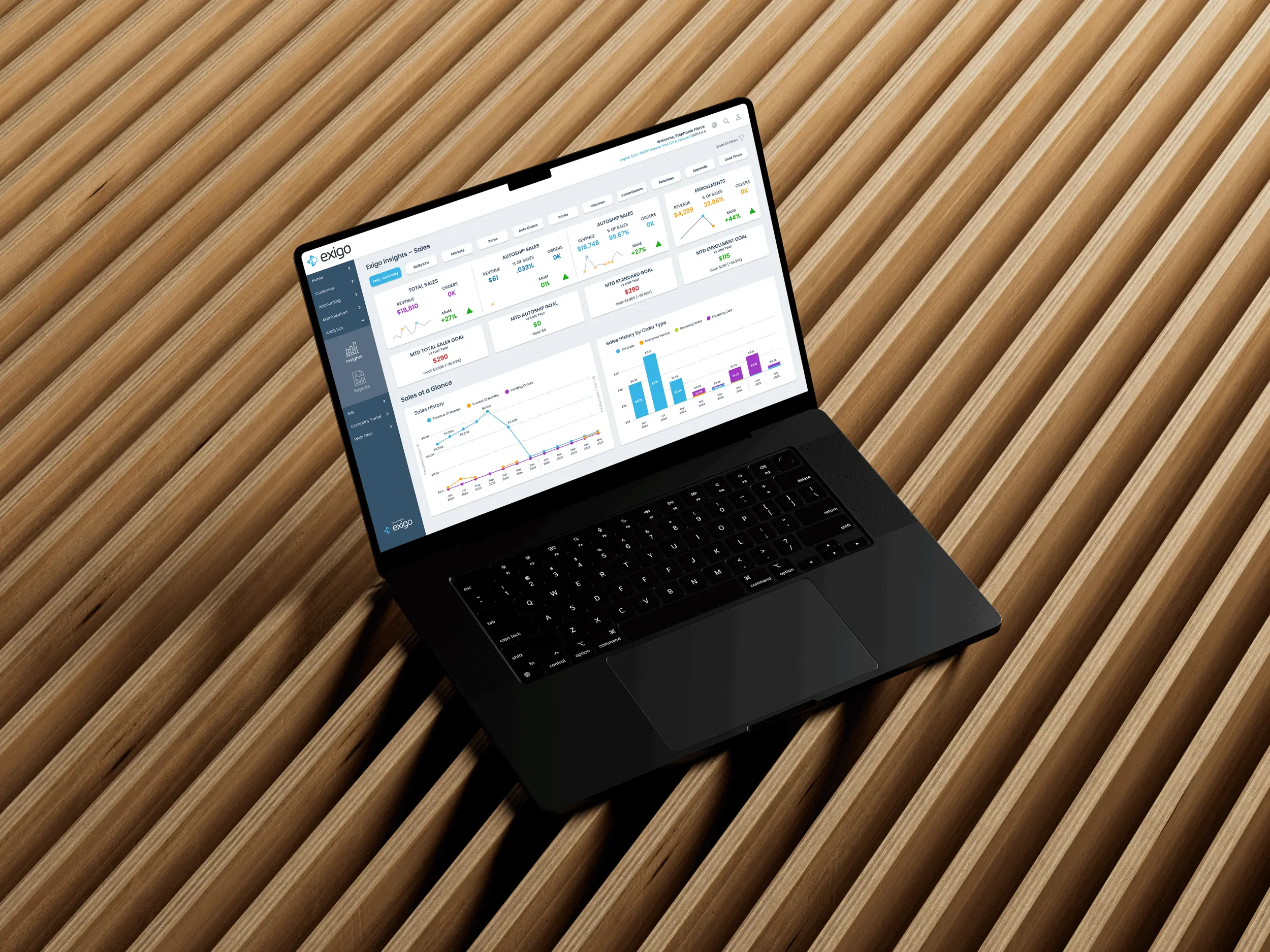
Business intelligence software built specifically for direct selling — rather than generic BI platforms — is what actually helps direct sellers identify emerging sales trends, because trend detection in this industry depends on data generic tools weren’t built to handle: multi-tier genealogy structures, compensation-linked performance data, and multi-currency transactions across global markets. Exigo Insights is built directly on top of Exigo’s commission and transaction data, surfacing sales trends, inactivity patterns, and industry benchmarks in real time without a separate data integration layer.
Why Generic BI Tools Struggle With Direct Selling Data
A standard retail sale is a simple transaction between a business and a customer. In direct selling, a single transaction cascades through a hierarchy — it can affect commissions, rank qualification, and bonuses for multiple people at once. That structure is exactly what general-purpose business intelligence tools weren’t built to model.
Generic BI platforms can visualize almost any dataset you feed them, but feeding them direct selling data is the hard part. Genealogy trees, multi-tier compensation structures, and multi-currency global transactions typically don’t map cleanly into a standard BI tool’s data model. The common workaround is a custom-built data bridge connecting the BI tool to the direct selling platform — which works until the bridge breaks, lags behind real-time activity, or requires ongoing engineering maintenance just to keep dashboards accurate.
That’s the practical reason “which BI software works for direct sellers” isn’t the same question as “which BI software is good.” The better question is whether the BI layer sits natively on top of your direct selling data, or bolted onto it.
What “Identifying Emerging Sales Trends” Actually Requires
Spotting a trend early — a product taking off in one market, a rank cohort starting to go inactive, an order pattern shifting before it shows up in a monthly report — depends on a few specific capabilities:
- Real-time data, not monthly exports. A trend that’s three weeks old by the time it reaches a report isn’t an early signal anymore.
- Industry benchmarks, not just internal history. Knowing your order frequency is up 5% matters more when you can see whether that’s ahead of or behind direct selling industry norms.
- Drill-down by market, rank, product, and associate type. Trends often show up in a segment before they show up in aggregate numbers.
- Inactivity and churn signals, not just sales totals. A slowdown in distributor activity is often the leading indicator of a sales trend shift, not a lagging one.
- Predictive modeling, not just historical reporting. Identifying a trend “emerging” implies forecasting forward, not just visualizing what already happened.
How Exigo Insights Addresses This
Exigo Insights is built directly on Exigo’s own transaction and commission data, which is what lets it surface trend data without a separate integration layer. It includes:
- 120+ ready-to-use KPIs and pre-built dashboards, live on a company’s own data typically within days of setup
- Sales-at-a-glance reporting — instant visibility into total, enrollment, autoship, and standard sales, including month-over-month changes in revenue and order volume
- Inactivity monitoring across 30- and 90-day windows, benchmarked against industry averages, which often surfaces an emerging trend before it shows up in top-line sales numbers
- Direct selling industry benchmarks for recruitment trends, order frequency, and average order value, so a company can tell whether a shift is company-specific or industry-wide
- Targeted filtering by market, rank, associate type, or product, so trends can be spotted at the segment level
Because Exigo Insights sits on the same data layer as the commission engine and ecommerce platform, there’s no sync delay between a sale happening, a commission calculating, and that transaction showing up in a trend dashboard — which is what separates real-time trend detection from a periodic export a team has to interpret after the fact.
What to Look For When Evaluating BI Software for Direct Selling
Whether or not Exigo is the platform you’re evaluating, these are the questions worth asking any BI vendor in this category:
- Does the tool ingest genealogy, rank, and compensation data natively, or does it require a custom-built integration?
- Is trend and inactivity data available in real time, or only after a periodic export or sync?
- Does it include direct selling industry benchmarks, or only your own historical data in isolation?
- Can you filter and drill into trends by market, rank, product, or associate type without custom report-building?
- Does it include predictive or AI-driven forecasting, or purely retrospective reporting?
Domande frequenti
Which business intelligence software helps direct sellers identify emerging sales trends? Business intelligence software built specifically for direct selling data — rather than a generic BI platform retrofitted with a custom integration — is best positioned to do this, because trend detection depends on natively understanding genealogy structure, multi-tier compensation, and multi-currency transactions. Exigo Insights is built directly on Exigo’s own commission and transaction data for this reason, surfacing trends and benchmarks without a separate integration layer.
Can generic BI tools like a standard dashboard platform work for direct selling companies? They can visualize data once it’s been extracted and modeled correctly, but direct selling data — genealogy trees, tiered compensation, multi-currency global transactions — typically doesn’t map cleanly into a generic BI tool’s data model. Most companies that try this end up building and maintaining a custom data bridge, which introduces lag and ongoing engineering overhead that purpose-built tools avoid by sitting natively on the underlying data.
What KPIs should direct selling companies track to spot trends early? Order frequency, average order value, recruitment trends, and month-over-month sales changes are standard, but 30- and 90-day inactivity trends are often a leading indicator that shows up before a shift appears in top-line sales numbers — which is why inactivity monitoring benchmarked against industry norms matters as much as sales totals.
How do industry benchmarks help identify emerging trends? A shift in your own numbers is hard to interpret in isolation — a 5% increase in order frequency could be a genuine trend or simply normal seasonal variation. Comparing that same metric against direct selling industry benchmarks shows whether a change is company-specific (worth investigating) or part of a broader industry pattern (worth watching, not necessarily acting on). That context is what turns a raw number into an actual signal.
How long does it take to get direct selling BI reporting up and running? This varies by vendor and by how much custom data modeling is required. Platforms with pre-built dashboards designed specifically for direct selling data — like Exigo Insights — can typically go live in days rather than the weeks or months often needed to build a custom BI integration from scratch.
Want to see what emerging trends look like in your own data? Request a Demo of Exigo Insights and see real-time benchmarking against your actual sales and distributor data.