
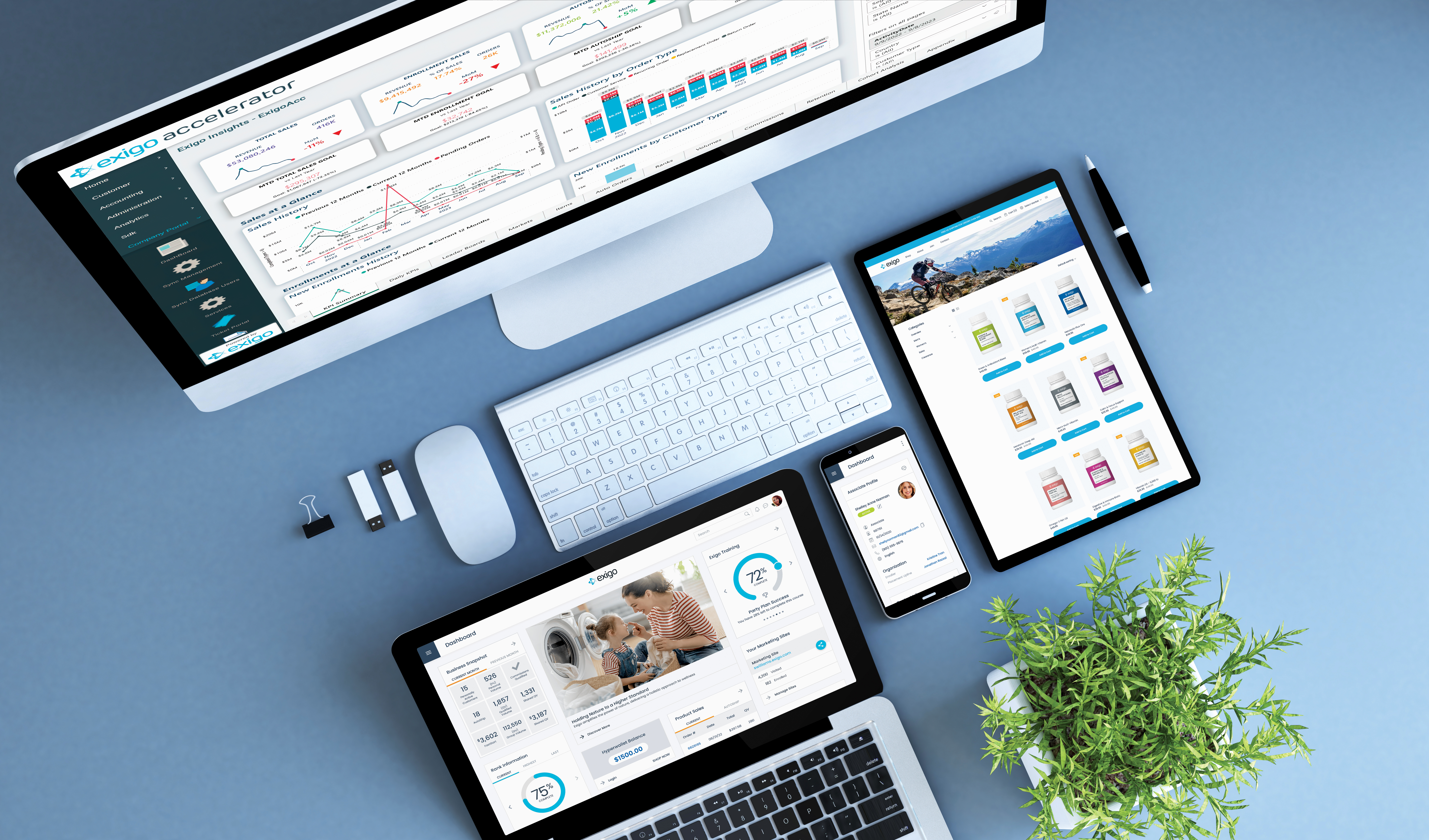


Direct Selling Operations Software: Exigo Core Platform
Posted On
November 24, 2026
By:
Rick Brisse
Direct selling operations software is the system that runs the day-to-day operation of a direct selling company: it calculates commissions, gives distributors a back office, gives corporate teams control of rules, orders, and reporting, and keeps ecommerce and business data connected. For enterprise companies, the strongest choice keeps those functions on a single set of data instead of stitching them together from separate products. Exigo Core is built that way.
Key Takeaways
- A core operations platform covers commissions, the distributor back office, corporate administration, and the connection to ecommerce and reporting.
- The decision that matters most is whether those pieces share one system of record or are connected after the fact.
- Enterprise buyers should test plan flexibility, commission accuracy, corporate control, open data access, global readiness, and migration experience.
- Exigo Core combines the commission engine, the Distributor Back Office, and Corporate Admin, and Exigo Insights adds real-time reporting on the same data.
What Is Direct Selling Operations Software?
It’s the core platform a direct selling or MLM company uses to run its business every day. Unlike a general ecommerce or CRM tool, it has to connect every order to a person in a team structure and calculate pay across that structure. A complete platform typically includes:
| Component | What it does | Why it matters at enterprise scale |
|---|---|---|
| Commission engine | Calculates commissions, ranks, and bonuses from your plan | Accuracy and trust, and the ability to test plan changes before they go live |
| Distributor back office | Where the field manages teams, orders, and earnings | Field experience, engagement, and fewer support requests |
| Corporate administration | Where your team configures rules, segments, promotions, and reports | Control over routine changes without waiting on developers |
| Orders and ecommerce connection | Captures orders from storefronts and ties each one to the right distributor | One record per order, with no sync gaps |
| Reporting and data | Shows performance and gives you access to your own data | Decisions made on current numbers |
| Integrations | Connects tax, payments, fulfillment, and other tools | Extensibility without breaking the core |
How Do Enterprise Direct Selling Companies Choose Core Operations Software?
The best approach is to evaluate against criteria you can test, not feature lists. These ten are a good starting point:
| Criterion | What to look for | Question to ask a vendor |
|---|---|---|
| 1. Plan flexibility and modeling | Support for your plan type and custom rules, plus a way to test changes before launch | Can you model my plan, including edge cases, before I sign? |
| 2. Commission accuracy and timing | Accurate calculations with timely, visible results | How do volume and rank update after an order? |
| 3. One system of record | Orders, distributors, and volume on the same data | Where does an order live first? |
| 4. Distributor experience | A mobile-friendly back office with team reports, rank progress, and autoship management | What can a distributor do without contacting support? |
| 5. Corporate control | Rules, segments, promotions, and reports managed in an admin console | Which changes can my team make without developers? |
| 6. Ecommerce connection | Storefront orders written directly to the system of record | How do storefront orders reach commissions? |
| 7. Open data and integrations | APIs and direct database access | Can I query all of my data myself? |
| 8. Global readiness | Multiple currencies, tax rules, and shipping rules by market | How is a new market added? |
| 9. Reliability and security | Published commitments and documentation | Can I review your uptime and security documentation? |
| 10. Migration and support | A proven process, parallel-run validation, and references | How many companies have you migrated, and can I speak with them? |
For a broader checklist, see our guides on what to look for in direct selling software and how to choose direct selling software in 2026.
How Do Network Marketing Firms Centralize Back Office and Ecommerce Software?
The goal is a single system of record: one place where distributors, orders, volume, and commissions live, so that a customer’s purchase doesn’t have to be copied from one system to another before it counts. There are three common ways to get there:
| Approach | How it works | Trade-off |
|---|---|---|
| Separate products linked by connectors | A storefront, a back office, and a commission engine from different providers, connected by integrations | Flexible choices, but more seams to manage. See the multi-vendor tax. |
| A core platform with a connected storefront | The core platform holds distributors, orders, and commissions, and a storefront you choose writes orders to it through APIs | Keeps one record while preserving your choice of storefront |
| A unified suite | Back office, commissions, admin, and the ecommerce layer are built on the same data | Fewest seams, with a commitment to one vendor’s ecommerce layer |
Exigo supports both of the last two. Core’s open APIs let you connect an ecommerce platform you already use, and Exigo’s own ecommerce layer, Experience Builder, is built on Core. For more on centralizing, read how to centralize your back office and ecommerce.
What Does Exigo Core Include?
Exigo Core is described as the operational backbone for direct selling, and it is more than a commission engine. It has three parts.
The commission engine
- Flexible plans, including binary, unilevel, matrix, and hybrid structures
- Compensation plan modeling in a secure sandbox, so you can test and refine a structure before it goes live
- Real-time visibility into performance, with dashboards that help you improve your compensation strategy
The Distributor Back Office
- A mobile-first hub where the field manages the day-to-day of their business
- Team reports that help sellers manage and grow their teams
- Rank progress and auto-order management, so sellers can see where they stand and keep their business moving
Corporate Admin
- Configuration of rules, field segments, and custom reports
- System-wide management, from commission rules to ecommerce settings and communication tools
- API connections to your existing systems, third-party solutions, and ecommerce platforms
- Content and promotion management across touchpoints
Core also exposes 220 open APIs and direct SQL access to your data, so you can connect other tools and query your data yourself. Exigo publishes its uptime and security commitments on the Core page, and you should review them directly as part of any evaluation.
How Does Exigo Core Provide Real-Time Business Data?
Real-time data comes from reporting that runs on the same data as the commission engine, not on a copy. Exigo Insights is built on that principle. It provides pre-built dashboards on top of your existing Exigo data, 120+ ready-to-use KPIs covering enrollments, retention, autoships, and commissions, and direct selling benchmarks that let you compare your performance with industry standards. Insights is fully managed and can be up and running in days, so reporting doesn’t become another project for your team.
Who Is Exigo Core For?
Exigo serves companies from startups and mid-size brands to global enterprises, so a growing company can start on the platform and scale without replatforming. It supports operations across 120+ countries and 40+ currencies, with configurable regional tax and shipping rules. The commission engine handles binary, unilevel, matrix, and hybrid plans, and Exigo also supports party plan models.
What Do Customers Say?
Jana Gilmore, Head of IT at pawTree, put the benefit of one platform this way: “Exigo really can save you [a lot of money] because you’ve got these features [commissions, back office, and admin] in an all-in-one tool.” Read more in the pawTree case study or browse all customer case studies.
What Does Migration to Exigo Core Look Like?
Exigo reports having completed over 400 migrations from legacy or competitor platforms. Timelines depend on scope, features, and how responsive the customer’s team and stakeholders are, so be cautious of any fixed number. Exigo uses parallel-run validation, running the new system alongside the legacy platform until the output matches before cutover. Our guide to how to switch MLM software walks through each phase.
Frequently Asked Questions
What is direct selling operations software?
The core platform a direct selling company uses to run its business: commissions, the distributor back office, corporate administration, and the connection to ecommerce and reporting, ideally on one set of data.
Is Exigo Core only for commission processing?
No. Core includes the commission engine, the Distributor Back Office, and the Corporate Admin module, which together cover daily direct selling operations.
What compensation plans does Exigo Core support?
Binary, unilevel, matrix, and hybrid structures, and party plan models. You can test a plan in a secure sandbox before it goes live.
What does “system of record” mean in direct selling software?
The single place where distributors, orders, volume, and commissions are stored and treated as the source of truth, so other systems read from it or write to it instead of keeping their own copies.
Can Exigo Core connect to an ecommerce platform I already use?
Yes. Core’s Corporate Admin supports API connections to existing systems, third-party solutions, and ecommerce platforms, and Core exposes 220 open APIs.
Do I need a separate back office from my commission software?
Not necessarily. Using a back office that runs on the same data as the commission engine reduces the number of systems to reconcile and keeps distributors’ views consistent with how they’re paid.
How does Exigo Core work with Exigo Insights?
Core is the foundation of the Exigo platform and is integrated with Insights, so reporting and dashboards run on the same data as your operations.
How long does it take to migrate to Exigo Core?
It depends on scope, features, and the level of participation from your team. Any timeline should include testing and at least one full parallel commission cycle.
If you’re evaluating core operations platforms, the best test is to see your own plan and data in one place. Talk to Exigo’s team, or learn more about Exigo Core.